
Mastering Dressmaking: Your Ultimate Guide to Fabric Textiles
Lesson 4: Unraveling the Secrets of Sewing Fabrics
Embarking on the journey of dressmaking is an incredibly rewarding experience, transforming simple ideas into wearable art. As you progress from basic stitches to intricate designs, one fundamental element will consistently influence the success and final aesthetic of your projects: fabric. The right fabric choice isn’t just about color or pattern; it dictates drape, comfort, durability, and even the techniques you’ll employ during construction. This lesson, the fourth in our comprehensive dressmaking series, will immerse you in the fascinating world of fabric textiles, equipping you with the essential knowledge to make informed decisions for every dress you create.
Understanding fabrics is akin to a chef knowing their ingredients. Each textile possesses unique properties that can elevate or diminish your design. A flowing maxi dress demands a fabric with excellent drape, while a structured A-line dress requires something with more body. Choosing wisely can simplify your sewing process and guarantee a professional, beautiful outcome. Our best advice for beginners is to start with stable woven fabrics in solid colors or simple prints. These fabrics are generally easier to cut, sew, and press, providing a forgiving learning curve as you master the art of dressmaking.
In this comprehensive guide, you will deepen your understanding of:
- A concise history and introduction to the world of textiles.
- Warp – The lengthwise threads, parallel to the selvage, forming the fabric’s foundation.
- Weft – The crosswise threads, perpendicular to the selvage, woven through the warp.
- Bias – The diagonal direction of the fabric, offering unique stretch and drape.
- Woven Fabrics – Textiles created on a loom with interlacing threads, generally offering minimal stretch.
- Knit Fabrics – Textiles made by interlooping threads, characterized by significant stretch and comfort.
- The distinct applications and advantages of using woven versus knit fabrics in dressmaking.
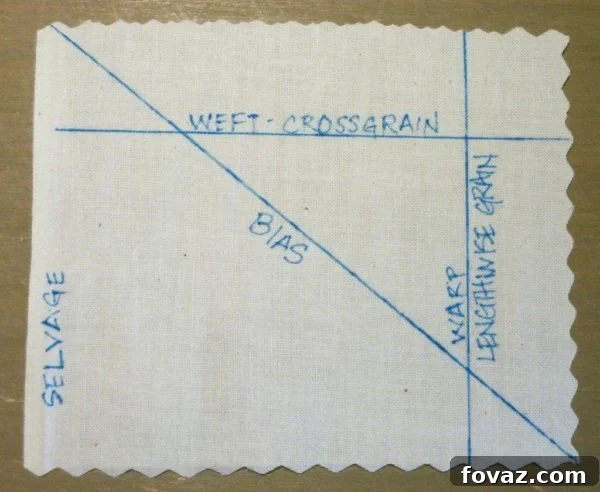
A thorough understanding of your fabric’s grain – specifically the warp, weft, and bias – is critically important for successful garment construction. These terms aren’t just technical jargon; they are fundamental guides that influence how your fabric will behave once cut and sewn. Incorrectly cutting a pattern piece can lead to a garment that twists, sags, or simply doesn’t hang right. Take time to familiarize yourself with these concepts, perhaps by examining fabric scraps. The accompanying image provides a detailed visual representation to help you distinguish between the warp, weft, and bias directions on any piece of fabric.
A Brief History of Textiles and Their Evolution in Dressmaking
The story of textiles is as old as human civilization itself, beginning with basic fibers twisted into threads and eventually woven into rudimentary fabrics. Early textiles were primarily derived from natural sources such as cotton, flax (linen), wool, and silk. Each culture developed techniques unique to its environment, creating fabrics that served practical needs – warmth, protection – and later, aesthetic desires. The Industrial Revolution brought about significant advancements, mechanizing processes like spinning and weaving, making fabrics more accessible and diverse. The 20th century introduced synthetic fibers like polyester, nylon, and rayon, expanding the possibilities for fabric properties, from stretch and wrinkle resistance to vibrant colors and enhanced durability. This rich history underscores the vast array of choices available to the modern dressmaker, each with its own legacy and practical applications.
Decoding Fabric Grain: Warp, Weft, and Bias Explained
Understanding fabric grain is paramount in dressmaking, as it determines how your garment will hang, stretch, and fit. Think of fabric as having a built-in direction.
- The Warp (Lengthwise Grain): These are the threads that run parallel to the selvage edge of the fabric. The selvage is the tightly woven finished edge that prevents fraying. Warp threads are typically stronger and more stable than weft threads because they are under tension during the weaving process. When you lay out your pattern pieces, aligning them with the lengthwise grain (or warp) ensures that your garment will hang properly and maintain its shape over time. Most pattern pieces are cut “on the grain,” meaning parallel to the selvage, to utilize the stability of the warp.
- The Weft (Crosswise Grain): These are the threads that run perpendicular to the selvage, interlacing with the warp threads. Weft threads usually have a bit more stretch or give compared to the warp, though still minimal in most woven fabrics. When cutting pattern pieces, you might occasionally align them with the crosswise grain for specific design effects, but generally, the lengthwise grain is preferred for stability.
- The Bias (True Bias Grain): This is the diagonal direction of the fabric, specifically at a 45-degree angle to both the warp and weft. The true bias is where woven fabric exhibits its maximum stretch and beautiful drape, even though the individual threads themselves have no stretch. Cutting fabric on the bias allows garments to mold to the body, flow gracefully, and create soft, undulating hemlines. Bias-cut dresses, skirts, and even bias binding strips are renowned for their elegant movement and luxurious feel. However, sewing on the bias can be trickier for beginners due to its inherent instability and tendency to stretch or distort.
Exploring Woven Fabrics: Structure, Characteristics, and Applications
Woven fabrics are characterized by their structure: two sets of yarns (warp and weft) interlacing at right angles on a loom. This interlocking creates a stable, generally non-stretchy fabric that holds its shape well. They are foundational in dressmaking, suitable for a vast range of garments from crisp shirts to tailored dresses and structured outerwear.
Key Characteristics of Woven Fabrics:
- Stability: Wovens offer excellent shape retention, making them ideal for structured garments.
- Minimal Stretch: Aside from the bias, woven fabrics have very little give, which is important for precise fitting.
- Durable: Many woven fabrics are robust and long-lasting.
- Prone to Fraying: Cut edges of woven fabrics will fray, requiring seam finishes like serging, zigzag stitches, or French seams.
Common Types of Woven Fabrics for Dressmaking:
- Cotton: A natural fiber, cotton is versatile and widely used.
- Broadcloth/Poplin: Smooth, crisp, medium-weight; excellent for beginner projects, shirts, and casual dresses.
- Chambray: Similar to denim but lighter; great for comfortable casual dresses.
- Denim: Sturdy cotton twill; used for structured dresses, skirts, and jackets.
- Voile/Lawn: Lightweight, sheer, and airy; perfect for delicate summer dresses or linings.
- Linen: Another natural fiber, known for its strength, breathability, and distinctive crisp drape that softens with wear. Ideal for summer dresses and relaxed styles.
- Silk: A luxurious natural protein fiber, celebrated for its smooth texture, beautiful drape, and subtle sheen.
- Charmeuse: Silky smooth, lustrous, drapes beautifully, often bias-cut for eveningwear.
- Dupioni: Crisp, textured with slubs, has a stiffer hand; good for more structured formal dresses.
- Crepe de Chine: Lightweight, matte finish, soft drape; suitable for elegant blouses and dresses.
- Wool: A natural protein fiber, providing warmth and excellent drape in various weights. Used for tailored dresses, winter garments.
- Rayon/Viscose: A semi-synthetic fiber derived from wood pulp, it drapes beautifully and has a silky feel. Excellent for flowing dresses and blouses, often mistaken for silk due to its drape.
- Polyester: A synthetic fiber known for wrinkle resistance, durability, and often blended with natural fibers. Can range from stiff to flowing depending on the weave.
Tips for Working with Woven Fabrics:
- Pre-wash and Dry: Always pre-wash your woven fabric as you intend to wash the finished garment to prevent shrinkage and color bleeding.
- Straighten the Grain: Before cutting, make sure your fabric is “on grain.” Gently pull opposite corners diagonally until the fabric lies flat and square.
- Pressing is Key: Press seams as you go. Wovens respond well to steam and pressing, resulting in crisp, professional finishes.
- Sharp Shears: Use sharp fabric shears or a rotary cutter for clean, precise cuts to minimize fraying.
- Finish Seams: Due to fraying, finish all raw edges with a serger, zigzag stitch, or binding.
Delving into Knit Fabrics: Flexibility, Comfort, and Modern Dressmaking
Knit fabrics are constructed by interlooping yarns, similar to hand knitting. This creates a flexible, stretchy fabric that is incredibly comfortable to wear and has become a staple in modern dressmaking, especially for casual wear, activewear, and comfortable dresses.
Key Characteristics of Knit Fabrics:
- Stretch and Recovery: Knits offer varying degrees of stretch, providing ease of movement and comfort. Good recovery means the fabric returns to its original shape.
- Drape: Many knits have a beautiful, flowing drape, perfect for relaxed silhouettes.
- Comfort: The inherent stretch makes knit garments exceptionally comfortable to wear.
- Less Fraying: Unlike wovens, most knits do not fray at the cut edges, though they can curl or ladder.
Common Types of Knit Fabrics for Dressmaking:
- Jersey: The most common knit, often made from cotton, rayon, or blends. It has a distinctive right and wrong side, curls at the edges, and drapes well. Ideal for T-shirt dresses, casual tops, and comfortable skirts.
- Interlock: A double-knit fabric, meaning it looks the same on both sides. It’s more stable, thicker, and has less curl than single jersey. Excellent for more structured knit dresses and children’s clothing.
- Rib Knit: Features vertical ribs on both sides, providing excellent stretch and recovery, especially in the crosswise direction. Often used for neckbands, cuffs, and fitted garments.
- Ponte di Roma (Ponte): A stable double-knit with a smooth, firm hand. It has good body and stretch, making it suitable for more tailored knit dresses, skirts, and trousers that require structure.
- Sweatshirt Fleece/French Terry: Looped texture on the wrong side, soft and cozy. Great for comfortable, casual dresses and loungewear.
- Spandex Blends (Lycra): Often blended with other fibers (cotton, polyester, rayon) to add significant stretch and recovery. Common in activewear and form-fitting dresses.
Tips for Working with Knit Fabrics:
- Pre-wash: Knits can shrink significantly, so pre-washing is crucial.
- Ballpoint/Stretch Needle: Use a ballpoint or stretch needle on your sewing machine. These needles have rounded tips that push fabric fibers apart instead of piercing them, preventing skipped stitches and holes.
- Stretch Stitches: Use a zigzag stitch, a stretch stitch setting on your machine, or a serger. Straight stitches will pop when the fabric stretches.
- Walking Foot: A walking foot can be very helpful for feeding knit fabrics evenly through your machine, preventing stretching and wavy seams.
- Avoid Stretching While Sewing: Let the machine feed the fabric. Do not pull or stretch the fabric as you sew, as this will distort your seams.
- Stabilize Where Needed: For areas like shoulder seams or necklines that might stretch out, use clear elastic or knit fusible interfacing to stabilize.
Woven vs. Knit: Choosing the Right Fabric for Your Dress
The decision between using a woven or a knit fabric is one of the most critical choices you’ll make in dressmaking. Your pattern will often specify the recommended fabric type, and it’s wise to adhere to these recommendations, especially as a beginner.
- For Structured and Tailored Dresses: Woven fabrics are generally the go-to. Their stability allows for crisp lines, defined waists, and intricate detailing like pleats, darts, and structured collars. Think of classic shift dresses, tailored sheath dresses, or full-skirted garments that require volume and shape.
- For Comfortable and Flowing Dresses: Knit fabrics excel in creating garments that prioritize comfort, flexibility, and a soft drape. They are perfect for casual dresses, body-con styles, wrap dresses, and any design where ease of movement is paramount. Knit fabrics allow for designs with minimal closures, as they can often be pulled on.
Consider the desired outcome: Do you want a garment with crisp lines and a defined silhouette, or one that flows smoothly and molds to the body? Your fabric choice will directly impact whether you achieve that vision.
Essential Fabric Considerations for Every Dressmaker
Beyond the basic categories of woven and knit, several other factors contribute to a fabric’s suitability for your dressmaking project.
- Fiber Content: This refers to what the fabric is made of (e.g., 100% cotton, polyester/spandex blend, silk). Fiber content influences breathability, drape, care requirements, and cost. Natural fibers like cotton, linen, silk, and wool are breathable and comfortable, while synthetics like polyester and nylon offer durability, wrinkle resistance, and often more vibrant colors. Blends combine the best qualities of different fibers.
- Weight and Drape: Fabric weight (lightweight, medium-weight, heavyweight) dictates how a garment will hang and feel. Drape describes how the fabric falls and folds. A lightweight voile will have a very different drape from a heavy denim. Consider the desired silhouette: a voluminous skirt needs a fabric with body, while a fluid, bias-cut gown requires excellent drape.
- Care Instructions: Always check the care instructions for your fabric. Some fabrics require dry cleaning, hand washing, or specific drying temperatures. Pre-washing your fabric according to these instructions is crucial to prevent future shrinkage or damage to your finished dress.
- Durability and Longevity: For everyday dresses, you’ll want a fabric that can withstand frequent wear and washing. For special occasion garments, durability might be less of a concern than aesthetic appeal.
- Cost: Fabric prices vary wildly. While it’s tempting to splurge on luxurious fabrics, beginners might find it more practical to practice on more affordable options.
Preparing Your Fabric for Dressmaking Success
Proper fabric preparation is a non-negotiable step that often gets overlooked by eager beginners. Skipping this stage can lead to frustrating issues like shrinkage, twisting seams, or a garment that doesn’t quite fit.
- Pre-washing and Drying: This is arguably the most important step. Wash and dry your fabric exactly as you plan to wash and dry the finished garment. This removes manufacturing chemicals, tests for colorfastness, and allows the fabric to shrink to its final size before you cut into it.
- Squaring Up the Fabric: After washing and drying, unfold your fabric and lay it flat. For wovens, gently pull on opposite diagonal corners until the crosswise grain is perpendicular to the selvage. This ensures your fabric is “on grain” and will hang straight.
- Pressing: Press your fabric thoroughly before cutting. Wrinkles and creases can lead to inaccurate cuts and distort your pattern pieces. Use the appropriate iron temperature for your fabric type.
Your First Steps: Beginner-Friendly Fabric Choices
As you embark on your dressmaking adventure, selecting the right fabric can make all the difference in your enjoyment and success. We strongly recommend starting with stable woven fabrics like cotton broadcloth, poplin, or even a lightweight denim. These fabrics offer:
- Ease of Handling: They don’t slip or stretch excessively, making them easy to cut accurately.
- Clear Grain: The warp and weft are usually visible, simplifying grainline identification.
- Responsiveness to Pressing: They hold creases well, aiding in sharp seams and professional finishes.
- Durability: They can withstand repeated stitching and unpicking (yes, mistakes happen!) without easily showing damage.
Once you’ve gained confidence with wovens, you can gradually introduce more challenging fabrics like silk or stretchy knits. Each fabric presents its own set of challenges and rewards, but a solid foundation built on understanding basic textiles will serve you well throughout your dressmaking journey.
Mastering fabric knowledge is an ongoing process, but by understanding the core principles of warp, weft, bias, and the differences between woven and knit structures, you’re well on your way to becoming a skilled dressmaker. This foundational knowledge will empower you to choose the perfect textile for every dress, ensuring your creations are not only beautiful but also well-constructed and comfortable to wear. Keep experimenting, keep learning, and most importantly, keep enjoying the creative process!