
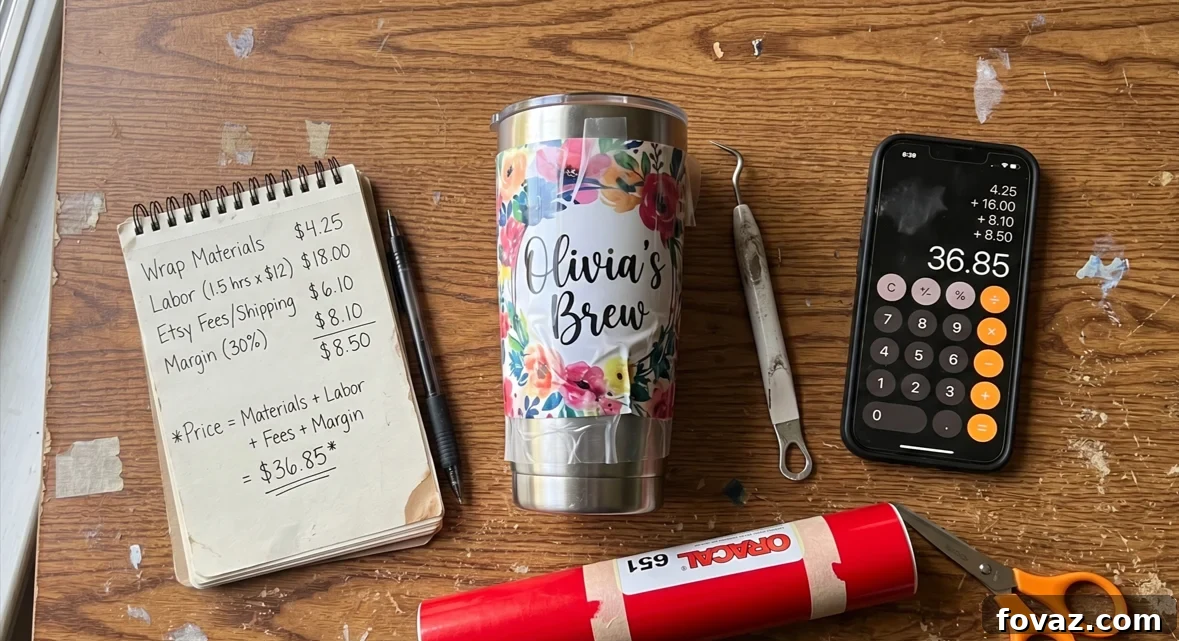
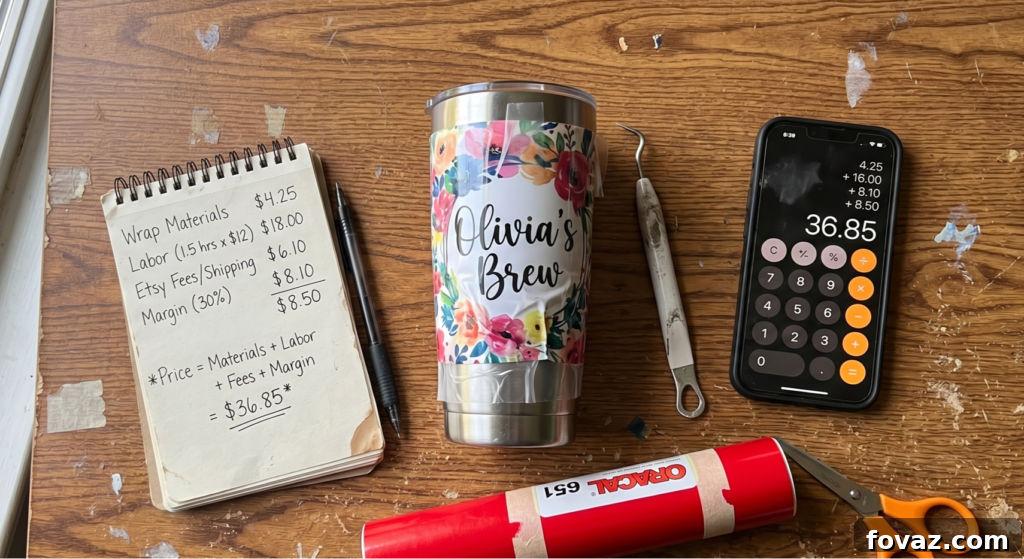
Quick Answer: Cricut Pricing Formula
- Use a clear pricing formula: Materials + Labor + Overhead + Fees + Profit Margin = Your Price.
- Price based on your actual costs, not what you would personally pay.
- Account for your time. If you don’t, you’re not running a business — you’re giving your labor away.
- A simple starting rule for beginners: (Materials × 3) + Labor + Fees. Increase the multiplier for custom, one-off work.
- Common errors include forgetting packaging, copying competitor prices, and cutting prices out of fear.
- Always do the math before accepting another order.
Someone messages asking the price for a set of personalized tumblers and you need a number fast. Guessing what feels fair or what you would pay leads to inconsistent pricing: you either undercharge and resent the work, or overcharge without confidence. Neither outcome builds a sustainable business.
Most makers start by guessing. The better approach is a reliable formula that replaces guesswork with repeatable math.
Pricing Is Math, Not a Feeling
A solid Cricut pricing formula removes guesswork. It won’t make every customer say yes, but it ensures you cover costs and pay yourself for time spent.
The formula:
Materials + Labor + Overhead + Fees + Profit Margin = Your Price
This formula works for tumblers, decals, shirts, wedding favors, and any other Cricut product. The components change by item, but the structure remains the same. Pricing by feeling leads to inconsistency; pricing by formula gives you a defensible, repeatable number.
Breaking Down Each Component of the Formula
1. Materials
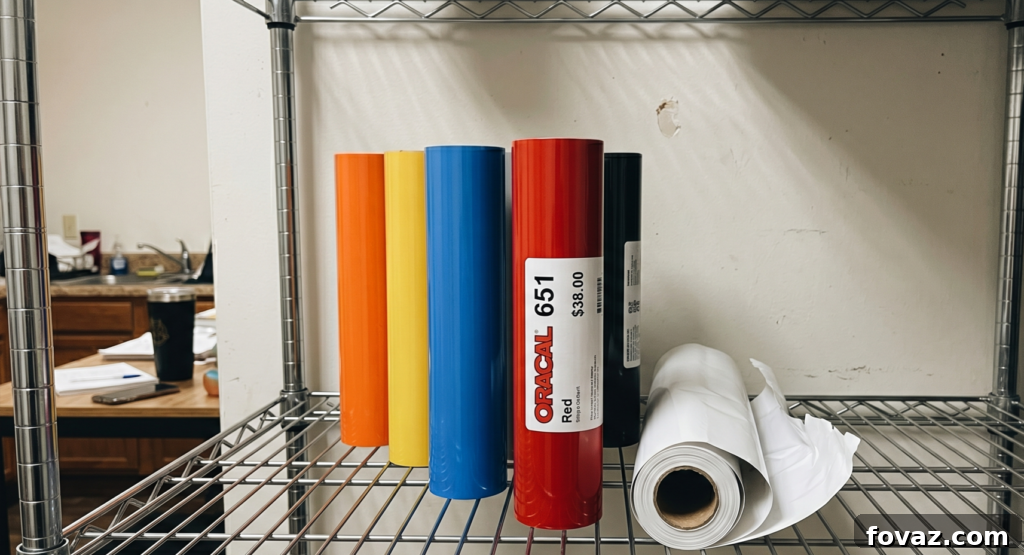
Materials are every physical item that goes into the final product: blanks, vinyl, transfer tape, packaging, and consumables. List each material, determine unit cost, and add them up. Include shipping on supplies and account for waste — miscuts and setup losses happen. A 10–15% buffer for materials is reasonable for beginners.
2. Labor and Time
Include design, cutting, weeding, application, finishing, and packing. Set and use an hourly rate — aim for at least $15/hour; $20–$25/hour is more realistic for skilled custom work. If a tumbler takes 45 minutes and you charge $20/hour, that’s $15 of labor to include in the price. Skipping labor means you’re effectively working for free.
3. Packaging and Overhead
Packaging has an actual cost: mailers, tissue, boxes, or branded wraps. Overhead covers the share of fixed expenses each order bears: your machine, software subscriptions, utilities, and workspace costs. For a small one-person operation, allocating $1–$2 per order toward overhead is a reasonable starting point. Omitting overhead hides real business costs and erodes profit.
4. Marketplace and Payment Fees
Fees reduce what arrives in your account. On platforms like Etsy you may face listing fees plus transaction and processing fees; direct payments through PayPal, Venmo, or Square also carry percentages. For many sellers, estimating 10–15% for platform and payment fees is a practical approach. Ignoring fees is a common beginner mistake.
5. Desired Profit Margin
Profit margin is the deliberate amount you add beyond covering costs. It fuels growth, cushions slow months, and funds equipment replacement. For custom, low-volume items a 20–30% margin is typical. Skipping margin means pricing to break even, not to sustain or grow a business.
Example: Pricing a Custom Tumbler Wrap
A practical example shows how the formula works. One custom 20oz tumbler sold on Etsy might break down like this:
| Component | Calculation | Cost |
|---|---|---|
| Blank tumbler | $75 / 50-pack | $1.50 |
| Vinyl | $12 roll / 20 wraps | $0.60 |
| Transfer tape | Per project estimate | $0.15 |
| Packaging (mailer + tissue) | Actual unit cost | $1.25 |
| Overhead allocation | Fixed cost share per order | $1.50 |
| Total Cost of Goods | $5.00 | |
| Labor | 45 min at $20/hr | $15.00 |
| Subtotal | $20.00 | |
| Etsy fees (approx. 13%) | $20 x 0.13 | $2.60 |
| Subtotal with Fees | $22.60 | |
| Profit margin (25%) | $22.60 / 0.75 | $30.13 |
| Final Price | Round to nearest dollar | $30.00 |
A $30 price for a custom tumbler on Etsy reflects materials, labor, fees, overhead, and a healthy margin. If that feels high, consider the implied hourly pay: pricing lower may mean you earn only a few dollars for skilled work.
Common Pricing Mistakes and How to Avoid Them
Not Paying Yourself for Time
The biggest error is omitting labor. Time is a real cost with real value. Set an hourly rate, write it down, and include it in every quote.
Underestimating Hidden Costs
Miscalculations, damaged blanks, wasted vinyl, and subscription fees add up. Track the first several orders to reveal what you missed and refine your estimates accordingly.
Copying Competitor Prices
A competitor’s price doesn’t reveal their costs, discounts, or business history. Use your own formula rather than guessing based on another seller’s listing.
Lowering Prices Out of Fear
Dropping price at the first hesitation conditions customers to expect discounts and undermines your pricing process. If your formula is correct, hold the line or offer a smaller, lower-cost alternative.
Before You Accept the Next Order: Do the Math
Before confirming a custom request, run the full formula for that item. Write down:
- Every material and its unit cost
- How long the job will take, start to finish
- Your hourly labor rate
- Packaging costs
- Platform or payment fees
- Your target profit margin
Add those numbers together — that’s your price. If it feels high, pause and evaluate rather than immediately lowering it. Remember: charging too little means you undervalue your skill and time.

Conclusion: Pricing Is a Skill That Improves
Working through the formula will feel slow at first. You’ll question rates and allocations. Do it anyway. Record the number, and charge it. The goal isn’t perfection on the first try — it’s replacing guessing with a process that improves with experience. After a handful of orders the math will feel natural and you’ll stop flinching at the results.
Most makers who underprice aren’t making a mistake of skill; they’re using the wrong method. Switch to a formula so your time and skill are reflected in every quote.
Take the Next Step
Use a one-page pricing checklist to calculate exact costs and price your next order confidently. Keep it near your machine and use it for tumblers, decals, shirts, and other personalized items.
Frequently Asked Questions
Q1: What is the best Cricut pricing formula for beginners?
A reliable starting point is: (Materials × 3) + Labor + Fees. The materials multiplier helps cover overhead and margin in one step.
Q2: How do I price Cricut orders on Etsy specifically?
Include listing, transaction, and payment processing fees before publishing the listing. For many sellers, accounting for roughly 10–13% of the sale covers typical Etsy fees; adjust for your actual rate.
Q3: Should I charge for design time?
Yes. Time spent in design and file prep is labor and should be included alongside cutting and finishing time.
Q4: What hourly rate should I use?
Use at least $15/hour as a floor. For skilled, custom work $20–$25/hour is more appropriate. Choose a rate you can consistently apply and justify when reviewing total order time.
Q5: What if a customer says my price is too high?
Don’t automatically discount. Ask what concerns them. If price is the issue, either hold your price or offer a simpler, lower-cost alternative with fewer customizations.
Q6: How do I price bulk orders differently?
Recalculate materials at bulk unit prices and spread setup time across more units. Efficiency gains lower per-unit cost while allowing you to maintain or improve margin.
Q7: Is the formula the same for all Cricut products?
Yes. The structure remains: Materials + Labor + Overhead + Fees + Profit Margin. The specific numbers vary by product.
Poll: The Pricing Debate
Which pricing rule should Cricut sellers follow?
Price based on what local customers will pay — even if that means your effective hourly rate falls below $10. A smaller margin is better than no sale.
vs.
Always price to pay yourself at least $15/hour, even if it costs some customers. Selling below your labor cost is not a strategy — it’s a path to burnout.
Cast your vote:
- [ ] Price for the market. Adapt to what buyers will actually pay.
- [ ] Price for your labor. Never work for less than $15/hour.
Leave a comment below sharing which approach you prefer and why.