
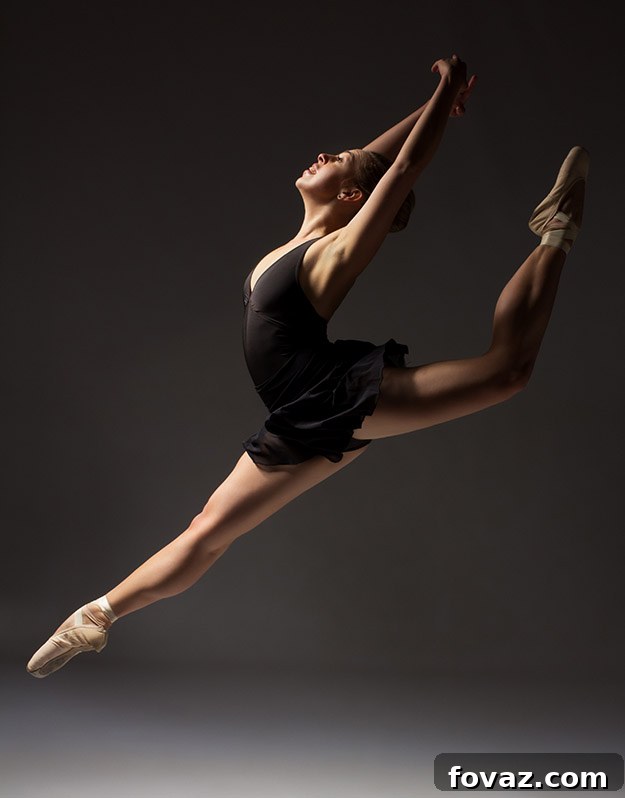
Want to defy gravity and soar through the air with unparalleled grace? While snagging the moon might still be out of reach, mastering the art of the leap in dance is an attainable goal for any aspiring dancer. With a blend of precise technique, dedicated practice, and a dash of artistic intent, you can significantly elevate your jumps and truly command the stage.
Elevate Your Dance: Essential Tips to Improve Your Leaps
The exhilarating spectacle of a dancer effortlessly suspended mid-air is a testament to years of rigorous training, incredible strength, and impeccable coordination. Professional dancers often make these gravity-defying feats appear seamless, embodying a powerful fusion of athleticism and artistry. As Dance Expert Treva Bedinghaus insightfully notes, “Some people seem to have a natural ability for jumping, whereas some have to work at it a little harder. Most leaps in dance require tremendous strength and coordination to execute correctly. However, practice makes perfect.” This statement underscores a fundamental truth: while talent can provide a head start, consistent, intelligent practice is the true key to unlocking your full potential.
Improving your leaps isn’t just about jumping higher; it’s about developing a comprehensive understanding of your body, refining your technique, and cultivating the mental focus required to execute each jump with power, precision, and artistry. By focusing on fundamental principles, dancers can build a solid foundation that not only enhances their aerial prowess but also significantly reduces the risk of injury. Treva Bedinghaus outlines three crucial tips that, when diligently applied, will help dancers improve their leaps by leaps and bounds, transforming hesitant hops into breathtaking aerial journeys.
1. Plie Deeper: Unleashing Your Power Potential
The plié is far more than a simple knee bend; it is the fundamental precursor to nearly all jumps and leaps in dance, serving as the critical spring that propels you skyward. A deep and correctly executed plié is absolutely vital for achieving the height, power, and control necessary for a successful leap. Think of the plié as loading a spring: the deeper and more controlled your bend, the more kinetic energy you store, which can then be explosively released to launch you into the air.
To execute an effective plié, ensure your knees track directly over your toes, maintaining perfect alignment to protect your joints. In a demi-plié (half bend), your heels should remain firmly on the ground, grounding your connection to the floor and maximizing your push-off potential. In a grand plié (full bend), your heels may lift slightly at the deepest point, but the focus remains on controlled descent and powerful ascent. Engage your core, inner thighs, and glutes throughout the movement. This muscular engagement isn’t just for power; it also provides stability and prevents excessive strain on your knees. The timing of your plié is also paramount; it should be a fluid, elastic motion that seamlessly transitions into the upward thrust of the leap, rather than a segmented stop-and-go action. By truly bending your knees and harnessing the strength of your legs, you create the essential foundation for a higher, more dynamic leap, transforming gravitational pull into aerial triumph.
Practicing deeper, more controlled pliés will build the necessary strength and muscle memory. Focus on slow, deliberate pliés to understand the full range of motion and muscle engagement, then incorporate quicker, more dynamic pliés to mimic the preparatory phase of a jump. Remember, the plié is not just a preparation; it is an integral part of the leap itself, dictating the height and quality of your flight.
2. Look Up: Guiding Your Body Skyward
The direction of your gaze plays a surprisingly significant role in the height and overall aesthetic of your leap. As you prepare to launch into your leap, make a conscious effort to look up. This simple action has a profound effect on the rest of your body. Our bodies instinctively follow the lead of our heads and eyes. If your gaze is fixed on the floor, your body will naturally tend to stay grounded and your spine will be inhibited from fully extending. Conversely, if you direct your gaze upward, your head will naturally lift, encouraging your neck to lengthen, your shoulders to open, and your entire spine to extend, creating a more elongated and expansive line through the body.
This upward gaze isn’t merely about tilting your head; it’s about setting an intention and guiding your entire physical being toward a higher plane. As you approach the apex of your leap, identify a high, distant spot in the space around you – perhaps a point on the ceiling, a distant corner of the room, or even an imaginary target. Fixate on this spot, and mentally aim to reach it with your highest point. Your body possesses an incredible capacity to strive for the goals you set for it, so by setting your visual and mental goals high, you empower your body to push beyond its perceived limits. This mental visualization coupled with a physical upward gaze will not only contribute to a higher vertical jump but also impart a sense of lightness, confidence, and artistry to your leap, making it far more captivating and visually appealing to an audience. A dancer with an upward gaze projects aspiration and control, enhancing the beauty and impact of their movement.
3. Control the Landing: Completing the Aerial Journey Safely and Gracefully
What goes up must inevitably come down, and the landing of a leap is every bit as crucial as its ascent. A leap is not truly complete until it is landed safely, quietly, and with control, readying the dancer for the next movement. The impact of a jump can be substantial, and managing this impact effectively is paramount for both performance quality and injury prevention. Here, once again, the deep plié emerges as a dancer’s most valuable tool.
Your primary goal for the landing should be to meet the floor as softly and quietly as possible. A loud, heavy landing is a clear indicator of poor control and excessive impact on your joints. To achieve a soft landing, you must absorb the force by engaging your leg muscles – your quadriceps, hamstrings, and glutes – in a controlled, deep plié immediately upon contact with the floor. This plié acts as a natural shock absorber, distributing the impact throughout your powerful leg muscles instead of directly jarring your knees, ankles, or spine. Never, under any circumstances, land a leap with straight or locked knees. Doing so places immense, dangerous stress on your knee joints, patella, and cartilage, almost invariably leading to sprains, strains, or more severe injuries over time. The knees are designed to bend and act as a hinge; denying them this function during impact is extremely hazardous.
The preparation for your landing should begin even before your feet leave the ground. Mentally preparing your legs to absorb your weight involves actively anticipating the impact and pre-engaging your core and leg muscles. As you descend, maintain a strong core to stabilize your torso, and keep your body aligned, ensuring your knees track over your toes as you plié. This conscious mental and physical preparation makes a profound difference, allowing you to land with precision, stability, and grace, transforming the final phase of your leap from a jarring impact into a seamless, controlled conclusion. A well-executed landing not only protects your body but also demonstrates mastery and elegance, leaving a lasting impression on your audience and preparing you effortlessly for the next choreographic phrase.
Beyond the Three Tips: A Holistic Approach to Leaping Excellence
While mastering the deep plié, upward gaze, and controlled landing forms the bedrock of exceptional leaping, truly extraordinary aerial performance requires a more holistic approach to a dancer’s training. Integrating these foundational tips with broader physical development will yield even more significant and sustainable improvements.
Core Strength: The Pillar of Stability
A powerful and engaged core is indispensable for all forms of dance, especially leaps. Your core muscles (abdominals, obliques, and lower back) act as the central powerhouse, providing stability during your ascent, maintaining your form in the air, and ensuring a controlled descent. Without a strong core, even the most powerful leg drive will result in a less stable, less aesthetically pleasing leap. Incorporate dedicated core strengthening exercises like planks, crunches, and Pilates into your routine to build this vital foundation.
Flexibility and Range of Motion
Optimal flexibility, particularly in the hip flexors, hamstrings, and calves, directly impacts the height and extension of your leaps. Restricted flexibility can limit your ability to achieve a deep plié or fully extend your legs in the air, hindering both height and line. Consistent stretching and mobility work will increase your range of motion, allowing for greater freedom and expression in your jumps. Dynamic stretches before class and static stretches post-class are essential.
Cross-Training and Conditioning
To prevent overuse injuries and build balanced strength, dancers benefit immensely from cross-training. Activities like swimming, cycling, yoga, and targeted strength training (with a focus on eccentric control and explosive power) can complement your dance training, enhancing cardiovascular fitness, muscular endurance, and overall body resilience. Consult with a dance-specialized trainer to develop a safe and effective cross-training regimen.
Patience, Persistence, and Professional Guidance
Improving your leaps is a journey, not a sprint. It requires patience, persistence, and a willingness to commit to consistent practice. There will be days of frustration and small victories. Embrace both. Most importantly, seek guidance from qualified and experienced dance instructors. A good teacher can provide personalized feedback, correct technique flaws, and offer specific exercises tailored to your needs, accelerating your progress safely and effectively. Their expert eye can spot nuances you might miss and provide invaluable corrections.
By integrating these three core tips—deep plié, upward gaze, and controlled landing—with a comprehensive approach to strength, flexibility, and professional guidance, you are not just learning to jump higher; you are evolving as a dancer. Each leap becomes an opportunity to express power, grace, and artistic intention, transforming your dance and captivating your audience.
Embrace the challenge, dedicate yourself to the process, and soon you’ll find yourself soaring to new heights, embodying the true spirit of dance with every breathtaking leap.
Love our post on how to improve your leaps? Then you’ll also like…
How To Make a Tutu Skirt | Easy No Sew Tutorial
Don’t forget to stay connected with us on Facebook, Twitter, Pinterest and Instagram!