
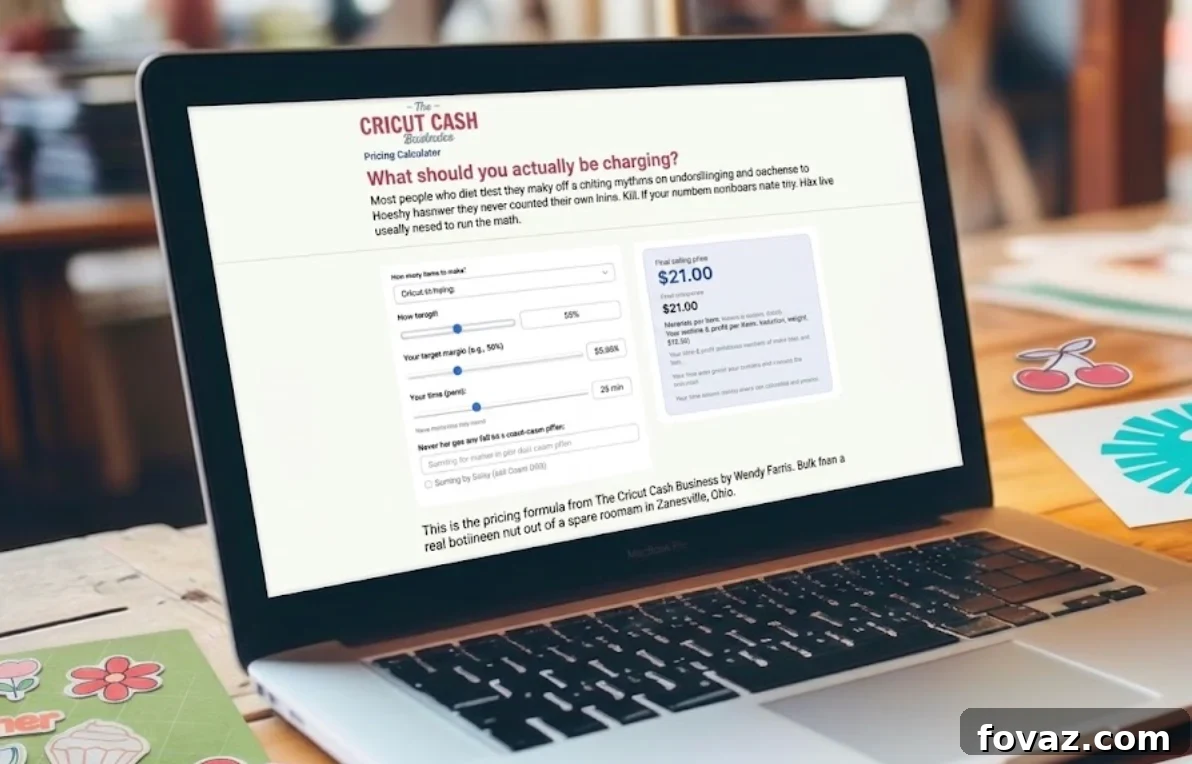
At a Glance: Free Cricut Pricing Calculator 2026
- A free Cricut cost calculator that delivers precise unit prices and total order amounts instantly.
- A straightforward Cricut pricing tool for makers who want to stop guessing, undercharging, or copying competitor prices from Etsy.
- It automatically factors in your time, materials, a 16% overhead, and a 30% profit margin so you get a reliable, profitable price you can quote with confidence.
If you plan to sell Cricut projects but aren’t sure how to price them, this resource is designed for you.
Many sellers pick numbers from Etsy, guess at a fair price, or set rates by feel. The result is often undercharging, inconsistent pricing, or giving work away because you’re unsure what to ask.
Pricing is the single biggest challenge for most Cricut businesses. The machines hum and orders arrive, but accurate costing remains guesswork. This guide and the calculator remove that uncertainty.
How Much Should I Charge for My Cricut Products?
Choosing the right price is one of the hardest parts of running a crafting business. Pulling a number from a marketplace listing or inventing a price on the spot risks paying yourself nothing for your work.
A correct price covers every real cost, and the cost many sellers overlook is their own time. Every order should have a price that ensures you profit or at least break even. No more finishing a job and wishing you had charged more.
Is There a Pricing Calculator for Cricut Products?
Yes. We created a free Cricut pricing calculator that takes the math off your plate. You don’t need spreadsheets or complicated calculations. Enter four simple details about an order and the calculator returns a per-unit price and a full-order total within seconds.
What changes when you use this calculator:
- You avoid undercharging: The tool highlights when your current price would leave you underpaid for that product.
- Your time is included: Labor is automatically added into the cost.
- Quotes you can trust: You receive a concrete number to offer customers instead of vague estimates.
- Bulk orders handled easily: Enter quantity and get both unit and total pricing instantly.
How to Use This Cricut Pricing Calculator
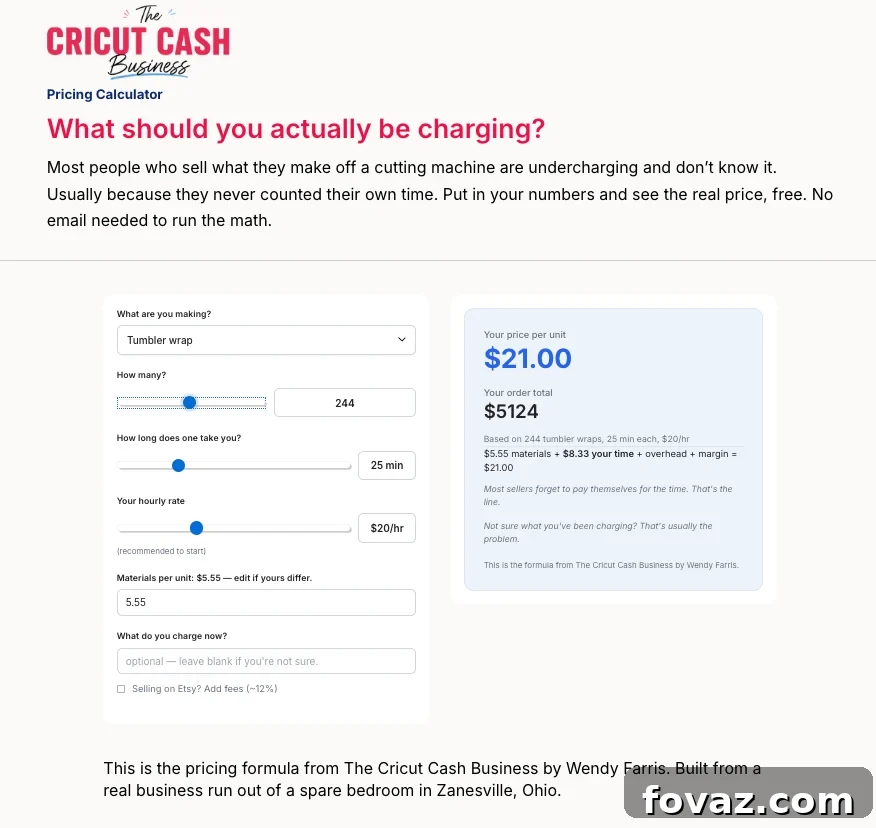
The calculator only needs four pieces of information you already know. Enter these inputs and get an accurate price:
- Pick your product: Select the item type from the dropdown—examples include tumbler wrap, car decal, wall quote, wedding favor sheet, or seasonal sticker pack. The tool applies the appropriate material cost automatically.
- Type in your quantity: Enter the number of units for the order. The calculator returns both a unit price and a full-order total.
- Enter your time: Choose the option that best represents your production time per unit. Time is treated like any material cost and added into the price.
- Set your hourly rate: Pick an hourly rate from the menu. $20/hr is a recommended starting point for new sellers, but you can set your own rate based on experience and local market.
How to Price Cricut Projects
The key to consistent pricing is a repeatable formula—not guessing. The calculator uses the same formula every time so your prices remain fair and sustainable.
When you click calculate, the tool totals materials and labor, applies a 16% overhead to cover equipment and supplies, and then adds a 30% profit margin to protect your business during slow periods.
Example math for a standard tumbler wrap:
- Materials: $5.55
- Time: 25 minutes at $20/hr = $8.33
- Subtotal: $13.88
- Overhead (16%): $2.22
- Profit margin (30%): $4.83
- Unit price: $20.93 (rounded to $21.00)
This result reflects the actual cost to produce that specific item—not a guess or a copy of another seller’s price.
Starting Prices for 5 Popular Cricut Products
Using the calculator’s formula and a $20/hr baseline, here are suggested starting prices for common items:
| Product | Starting Price |
| Car decal | $8.50 |
| Seasonal sticker pack | $9.00 |
| Wedding favor sheet | $11.00 |
| Tumbler wrap | $21.00 |
| Wall quote (long) | $42.00 |
Note: These figures are outputs of the formula and represent baseline floor prices. Your actual price should reflect design complexity, color changes, customization, turnaround expectations, and your local market. Complex multicolor decals or intricate wall quotes often require higher pricing based on actual cut and assembly time.
What to Do When a Customer Pushes Back
Customers will sometimes say your price is higher than they expected. Avoid immediately lowering your rate—discounting undermines long-term sustainability.
Instead, offer scope. For example:
“I can do eight at that price if that fits your budget.”
That response preserves your unit price while giving the customer a practical option. Stop habitually discounting; scoping keeps your business healthy while still working with clients.